Novigi · The Quarterly · Q4 2026

Data and Technology in Wealth Management

This edition, unsurprisingly, talks a lot about AI: how it's influencing everything from workforce design and software development to enterprise architecture and technology services.
July 2026

4 articles

~27 min read

4 contributors
July 2026

4 articles
~27 min read

4 contributors

Start reading

Overview

The Quarter at a Glance – Q4 FY26

Welcome to Novigi’s Quarterly Report — Q4 FY2026. The Quarterly is our regular publication covering topics in data, technology and wealth management. Each edition draws on the expertise of people across our team and the ideas, trends and questions occupying them at the time, whether emerging from our work with clients or broader developments across the industry.

Hopefully you can take some time out of your day to spend a moment with these few concepts we think are worth exploring. If you have any feedback or questions, we’d love to hear from you through our website or by reaching out to one of the Novigi team directly.

Covered in this quarter’s report:

Of Foxes and Hedgehogs: Superannuation’s Workforce in the Age of AI

In this technology article, we focus on people. It’s now well-established thinking that as AI increasingly takes on routine and predictable work, humans will focus on using their judgment, empathy, adaptability and deep contextual understanding. We explore how this may reshape workforce design in superannuation, the growing importance of generalist skills vs specialist skills and the challenge of developing and capturing expertise.

Beyond LLMs: The Next Frontier of AI

Large Language Models have dominated the AI conversation, but a growing number of researchers are questioning whether this is the architecture best suited to handling every problem it is currently being asked to solve. We explore the rise of so-called “world models” as an alternative, why they are attracting attention, and what the next generation of AI systems could look like. For superannuation, it raises the prospect of AI that understands situations rather than simply language, potentially allowing complex decisions to be handled more consistently.

Reports of SaaS’s Death…

If the cost and effort of creating software continue to collapse, what does that mean for the software industry itself? In this article, we unpack the much-discussed concept of “SaaSpocalypse” and revisit the perennial build-versus-buy debate. We explore what AI-assisted development genuinely changes, what it doesn’t, and why the implications for core platforms may be very different from those at the edges of an organisation’s technology landscape.

How the IT Service Desk is Changing

What happens when more than half of service desk requests can be resolved without human intervention? Drawing on our own experience, this article explores how AI is reshaping managed IT services and moving the focus away from simply processing tickets towards prevention, resilience and proactive improvement. We also examine why this shift is particularly significant in regulated industries, where governance, security and auditability remain are just important as speed and efficiency.

Superannuation

Of Foxes and Hedgehogs: Superannuation’s Workforce in the Age of AI

This is the fifth and final article in our series on superannuation’s underdeveloped operational infrastructure. We’ve worked through core IT systems, interoperability and, most recently, processes. In the very first article we filed the last of our concerns under the heading of “staffing”. It was, in hindsight, perhaps a slightly unfortunate word: it conjures rosters and headcount when the real subject is people — how they are hired, developed, organised and relied upon to keep the system running. So we’ll talk about “people” here.

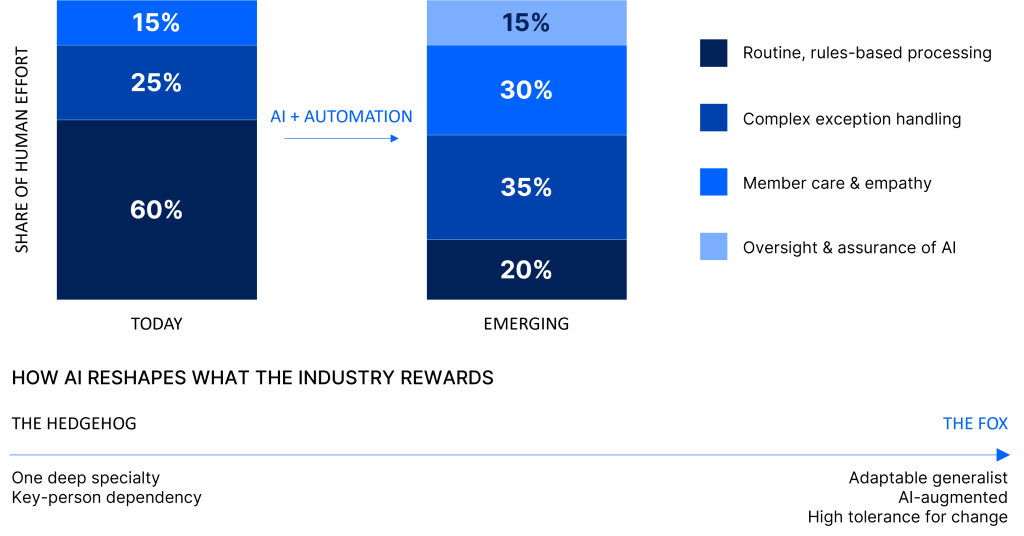
The ancient Greek poet Archilochus left us a fragment that Isaiah Berlin later made famous: “the fox knows many things, but the hedgehog knows one big thing”. Superannuation operations have long been built and run by hedgehogs — deep specialists who have decades of experience in one system, one process or one product. Our argument here is that artificial intelligence is changing what the industry needs, tilting it towards the fox: the adaptable generalist with a high tolerance for change and, crucially, high social and emotional intelligence. This is not an argument against expertise — certain domains will always require deep experience. It is an argument about which kind of expertise the next decade will reward.

More fox than hedgehog

The broader labour market is already moving this way. The World Economic Forum’s Future of Jobs Report 2025 estimates that 39% of workers’ core skills will change by 2030, and ranks resilience, flexibility and agility second only to analytical thinking among the capabilities employers now prize. Tellingly, the sector the Forum labels “Insurance and Pensions Management” — our own neighbourhood — leans on these traits harder than almost any other: 94% of its employers rate resilience, flexibility and agility as core, against a global average of 67%, and 83% say the same of curiosity and lifelong learning.

The reason is not mysterious. As AI absorbs the well-defined, repeatable parts of a role, what is left for the human is the part that is ambiguous, cross-disciplinary and changeable — work that rewards someone who can move between a registry quirk, a member’s distress and a regulator’s expectation without being retrained from scratch each time. McKinsey’s research on human–machine skill partnerships makes a complementary point: more than 70% of the skills employers seek today aren’t tied exclusively to either automatable or non-automatable work, they are used across both. So most human skills will endure — but will be applied differently. The generalist who can carry those skills across changing context and effectively wield the tools, rather than compete with them on specialist knowledge, is the one who compounds in value.

The changing shape of superannuation

As AI absorbs routine processing, human effort concentrates in judgement and member care.

Based on early assumptions Novigi has made on the implementation of AI agents in superannuation administration.

When the exception becomes the job

In our last article we drew a line between the “happy path” — the straight-through processing that systems are designed for — and everything else: the exceptions, edge cases and reconciliations where the cost and the risk actually live. AI is very good at the happy path. What it hands back to people is a job increasingly concentrated in the exceptions, and many of those exceptions are not technical puzzles but human ones.

Consider death benefit claims. In March 2025, ASIC’s landmark review found excessive delays and, in more than a quarter of the files it examined, poor customer service — communication it called ineffective and insensitive at precisely the moment grieving families needed the opposite. The regulator’s follow-up in 2026 recorded real progress but warned that claim volumes are climbing with an ageing population, and pointed to looming mandatory member-service standards built around the timely and compassionate handling of claims. The implication for workforce design is pointed: the residual human work in superannuation is disproportionately the emotionally demanding work. Empathy, judgment and the ability to explain a hard outcome clearly are no longer nice-to-haves at the edge of the process. Increasingly, they are the process.

The apprenticeship paradox

There is a catch the industry has barely begun to confront. The judgment that exception handling demands has traditionally been built on the job — by working through thousands of routine cases until the unusual one becomes recognisable. If AI now handles the routine cases, where do the next generation of specialists serve their apprenticeship? Funds and administrators will need to be deliberate about this: designing roles, rotations and training that build seasoned judgment on purpose, rather than assuming it will accumulate as a by-product of volume that no longer exists.

Getting knowledge out of people’s heads

Which brings us to the oldest people-risk in the book. We noted in the first article of this series that superannuation’s operations lean heavily on institutional knowledge held by a small number of key people. In that context, it was expertise of legacy technologies and ageing platforms, here we’re thinking about;  the one person who knows why a particular reconciliation runs the way it does, and whose annual leave is a source of some organisational nervousness. This “key-person dependency” is a resilience problem dressed up as a staffing convenience.

Here, encouragingly, AI helps rather than threatens. The same technologies reshaping the front line are unusually good at capturing, structuring and surfacing knowledge — turning the undocumented lore in someone’s head into something searchable, teachable and auditable. Done well, this democratises expertise: a newer team member, supported by good documentation and good tools, can safely handle what once required the person who “just knew”. None of this is automatic. Knowledge management does require structure and discipline. We run internal “academy” programs at Novigi precisely because getting expertise out of individual heads and into the collective takes deliberate effort. The technology lowers the cost of that effort, but on any horizon we can reasonably see today, it does not remove the need for it.

A few things worth watching

If ‘people’ are to be considered first-class operational infrastructure, a handful of questions deserve more attention:

  • Change fatigue and wellbeing. What will employers do to support a workforce asked to absorb constant change and to specialise in emotionally heavy work to avoid churn?
  • Accountability in AI-enabled operations. When an AI-enabled process produces an unexpected outcome, where does accountability sit, and can the reasoning behind that outcome be reconstructed months or years later if challenged by a regulator?
  • The administration question. Given much member servicing is outsourced or offshored how much will those arrangements need to be reshaped with a shift towards judgment-and-empathy work?
  • New pathways in. If the old ladder is disappearing, how will funds create fresh career paths into operations that do not depend on years of manual repetition?

The human touch, deliberately designed

The prevailing narrative around AI is that it allows organisations to do the same work with fewer people. What we’re digging into here — that we think is especially relevant for superannuation — is both the case for redirecting human effort and the nature of the work it is redirected towards as routine work recedes and judgment, empathy and adaptability move to the fore.

Building a workforce for that requires organisations to preserve hard-won expertise, reduce their dependence on individual knowledge holders, and deliberately develop the capabilities that become more valuable as AI takes on routine tasks. The challenge is creating an environment where deep expertise, hedgehogs, and adaptability, foxes, reinforce one another

Given where we sit — at the intersection of data, technology and operations in this industry — it is a shift we find both significant and fascinating, and one we intend to keep working through alongside our clients. Get it right, and the result should be evident to members: more efficient operations behind the scenes, and stronger human support where it’s most needed.

World Models

Beyond LLMs: The Next Frontier of AI

Recently, a quiet but monumental shift rippled through the upper tiers of artificial intelligence. Yann LeCun, a foundational “godfather” of modern deep learning and the long-standing Chief AI Scientist at Meta, departed the tech giant to co-found Advanced Machine Intelligence Labs (AMI Labs). Backed by more than US$1 billion in seed funding from major global technology entities, AMI Labs is notably not building another Large Language Model (LLM). Instead, its core thesis is that LLMs are a brilliant but fundamentally limited architectural path on the journey to true machine intelligence.

This is no longer a fringe debate. A growing contingent of generative AI pioneers are questioning LLM’s capacity to go the distance. Around the same time, independent researchers unveiled LeWorldModel, an open-source prototype of an alternative paradigm: World Models. The early indicators are commanding attention:

  • EchoJEPA: A medical vision world model achieved 79% diagnostic accuracy on cardiac ultrasounds using just 1% of the labelled data required by conventional models, with only a 2% accuracy drop under noise versus 17% for competitors.
  • V-JEPA: Tested on robotic arms in unfamiliar environments, this model successfully manipulated unknown objects 80% of the time versus 15% for legacy models.

Whether world models displace or complement LLMs remains open, but for enterprise leaders managing long-term technology roadmaps, the strategic question is: what architecture needs to sit behind the LLM?

Defining the boundary of LLM capabilities

LLMs have transformed enterprise productivity by mastering human communication. Their architecture predicts the most probable next word in a sequence, making them unmatched for natural language interfaces and content generation. However, their mechanism is linguistic pattern matching rather than causal reasoning, which creates specific boundaries:

  • Communication vs. Verification: LLMs excel at generating plausible, fluent text, but they are not designed to verify factual correctness or represent structural uncertainty.
  • Prediction vs. Simulation: Strategic planning requires modelling cause and effect, simulating what happens over time if an organisation executes one decision over another. Because LLMs predict tokens rather than simulating operational outcomes, multi-step planning falls outside their native design.

These are not critiques, they acknowledge that language processing has been maximised, clearing the path for complementary reasoning architectures.

From recipe collectors to master chefs

Consider the difference between memorising ten thousand recipes and knowing how to cook. A recipe collector can recite a complex French reduction verbatim, but if the kitchen runs out of an ingredient, the oven runs hot, or a guest has a severe allergy, the collector fails. There is no pre-existing text for this exact combination.

A master chef improvises effortlessly because they have internalised the underlying textures, flavours and cooking techniques. They model the kitchen in their minds rather than memorise a static list.

LLMs (The Recipe Collector) World Models (The Chef)
Predicts the next word Learns underlying structures
Pattern matches surface text Simulates cause and effect
Fails under novel anomalies Adapts to unfamiliar dynamics

LLMs are recipe collectors scaled to the internet. World models attempt to build the chef, learning the structural mechanics of an environment rather than predicting text.

Systems like V-JEPA achieve this via Joint-Embedding Predictive Architecture (JEPA), which trains in a “latent space”, focusing on high-level concepts and causal relationships rather than predicting every pixel or word. The model learns that objects drop, liquids spill, and forces yield predictable reactions, allowing it to reason for entirely novel environments.

The new enterprise division of labour

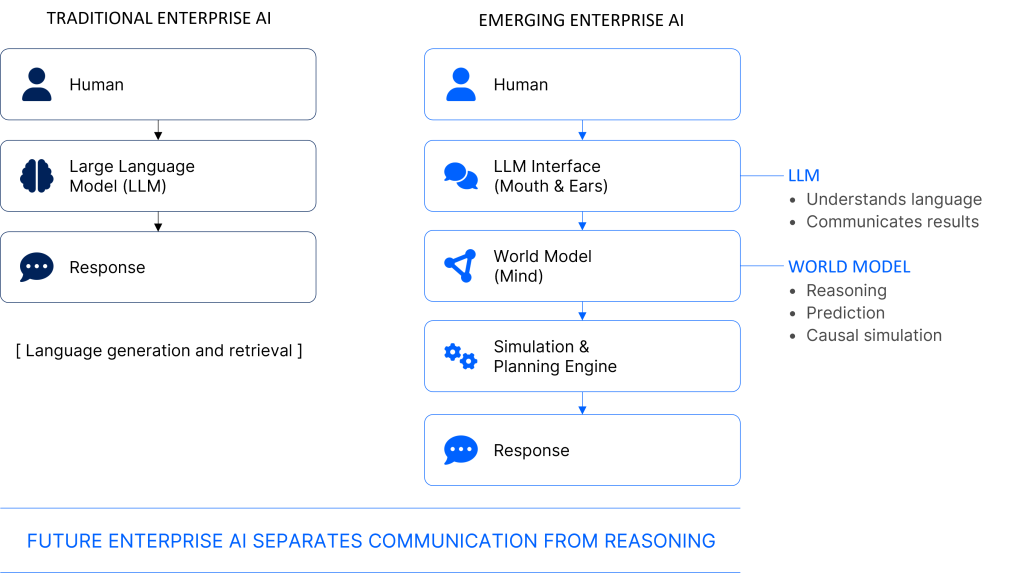
Enterprises have forced LLMs to handle both communication and reasoning, yet they were only architected for the former. The emerging paradigm separates these responsibilities:

  • The LLM Front-End (The Mouth & Ears): Translates complex human language into structured, semantic data that the system can process, and turns the final output back into natural, empathetic human prose.
  • The World Model (The Mind): Conducts the underlying reasoning, goal planning, and predictive simulation of outcomes, unburdened by the mechanics of sentence structure.

For data-rich, regulated sectors like superannuation, this solves a critical vulnerability. Today, AI sits in front of the enterprise as a chatbot wrapper. Tomorrow, it will sit inside the operational core.

Why superannuation is architecturally primed for world models

Much of what a fund does is applying fixed rules to endlessly variable human situations. Death benefit distributions apply the same legislative and trust deed provisions to family circumstances that are never the same twice. Insurance claims measure individual medical facts against fixed policy definitions. Financial advice, complaints handling, and unit pricing exception management share the shape: a stable rule set, an unpredictable reality, and an obligation to reach the same correct outcome every time the same facts recur.

This is where the architectures diverge. An LLM answers to how a case is worded, so near-identical situations described differently can produce different answers, and the reasoning is hard to audit. A rules engine is consistent but brittle, stalling on the exceptions, which is where the real work lives. A world model is suited to the ground between them: reasoning over an internal model of the rules and the member’s state rather than the surface text, which points toward outcomes that are more consistent and easier to stand behind when the facts are novel. This is a claim about direction, not a settled result, but it is the capability these processes require.

A contact centre request makes the layers concrete: “Should I consolidate my multi-employer super accounts and increase my insurance coverage?”

  1. Ingestion: The LLM front-end parses the member’s speech, sentiment, and intent.
  2. Semantic Mapping: The intent is mapped onto the fund’s data foundation, member history, product rules, regulatory bounds, and market data, organised via vector embeddings.
  3. Causal Simulation: The world model simulates long-term consequences across a 40-year horizon, premium erosion, fee changes, and legislative parameters.

Superannuation is a domain of state, time, and causality: multi-decade horizons and legislative ripples that take years to manifest. When this shift occurs, the determinant of AI value will be the integrity of the data foundation, not the sophistication of the front-end chatbot.

The strategic blueprint: preparing for the shift

World models are not yet commercially mature, but the data foundations they require take time to build. Organisations focused solely on front-end LLM tooling risk an irreversible competitive gap.

Architecture teams should watch for two commercial signals: the emergence of industry-specific pre-trained world models and native world-model support from major cloud providers. Either milestone will mark the tipping point toward mainstream adoption.

To prepare, business leaders should unify AI and data governance strategies and ensure operational processes are consistently documented. Technology architects should consider the shift to semantic data pipelines and eliminate interoperability gaps between core systems. Engineering teams should pilot reasoning-heavy use cases and stress-test data lineage end-to-end. The lasting competitive advantage will come not from the chatbot interface, but from the strength of the enterprise data foundation beneath it.

Whether world models ultimately displace LLMs, complement them, or evolve into something else entirely remains to be seen. More certain is that somewhat tired piece of advice that strong foundations are important. Organisations that invest here will be better positioned to take advantage of whatever comes next.

It’s genuinely exciting for us as we watch this all play out. We’re looking forward to seeing how these technologies evolve and how we can continue to put them to work in the industry.

Software

Reports of SaaS’s death…

“Saaspocalypse” is one of those terms that has been circulating just long enough to be familiar, but not quite settled. It has also been around long enough — and discussed widely enough — that we can move beyond reacting to it, and start to form a clearer view on what it actually means in practice.

For the uninitiated, SaaS stands for Software as a Service. It is a cloud-based software delivery model where a provider hosts applications and makes them accessible to users over the internet, typically through a web browser or mobile app.

Instead of purchasing, installing, and maintaining software locally on your own computers and servers, you rent or subscribe to it.

So, the origin of SaaSpocalype  is fairly straightforward — if tools like GitHub Copilot, Replit, Claude Code and other AI-assisted development tools make it dramatically easier to build software, then the rationale for buying it (particularly repeatedly, on a subscription basis!), starts to shift. The “SaaSpocalypse” was certainly felt in February of this year when a major AI product release triggered a sharp market reaction. In a single day, around $300 billion in value was wiped from SaaS and software-heavy companies, with major players like Salesforce, ServiceNow, and Adobe falling by roughly 7%, and Intuit dropping nearly 11%.

Organisations that once depended on vendors to provide functionality may therefore begin to revisit that familiar question of “should we build, or should we buy?

This is not a new conversation. Nor is it a fringe one.  “Build vs buy” has been debated for decades. Variations of this argument have been discussed in venture circles, engineering communities, and boardrooms for many years.

What’s changed? What hasn’t?

The barrier to building software has always been less about ideas and more about effort.

Teams needed specialist skills, time, and coordination to translate a requirement into something usable, supportable, and secure. For most organisations, it made sense to buy software that already solved those problems — even if it meant some compromise.

That underlying logic has not changed.

What has changed is the level of effort now required to build something useful. Tools that assist with code generation, testing, and deployment have made it significantly easier to create applications quickly. Tasks that once required a full development cycle can now be prototyped — and even productionised — in a fraction of the time.

Despite all this, we’re confident to say SaaS is not disappearing. It’s always interesting to note in the context of this discussion that even the companies at the centre of this shift continue to rely on it. Anthropic, for example, is reported to use Workday for HR, and OpenAI has also been confirmed as a Workday customer for core enterprise operations.

The idea that organisations will suddenly abandon all subscriptions and rebuild everything themselves is not a serious one.

Why SaaS isn’t going away

At its core, SaaS vendors do more than provide functionality. What keeps them entrenched is less the complexity of the software itself than data and integration. Providers such as Salesforce act as custodians of client data — controlling how it is consumed and accessed while the client still owns it. Platforms like Workday and ServiceNow manage heavily integrated workflows that span the entire enterprise architecture.

Systems of record — whether for payroll, accounting, registry, or core administration — embed years of regulatory logic, edge cases, integrations, and operational processes. Replacing them is not simply a matter of replicating features. It requires taking on the ongoing burden of maintenance, compliance, and support.

There is a commercial dimension too. Enterprise customers typically sign multi-year deals with complex commercial arrangements that make it difficult to simply opt out. This is a key reason the shift is not an immediate threat, even if it sits on the horizon.

What organisations should be doing

Where we think AI-assisted development will make the most immediate difference is not in replacing core systems, but in how organisations work around them.

Specifically, in using AI to customise existing systems, or to build smaller, targeted tools that sit alongside them — work that would previously have been handled through configuration, workaround, or an additional SaaS product, add on, or marketplace app.

This holds true for super funds. Members, regulators, and operating environments all depend on stable, well understood systems of record. Replacing those systems simply because it is now easier to build software would introduce more risk than it removes.

Instead, the opportunity sits at the edges. It is likely to be most valuable in areas that are:

  • Narrow in scope
  • Well understood
  • Heavily manual
  • Or poorly served by existing tools

None of these feel particularly transformative in isolation, and certainly not “apocalyptic”. But taken together, they represent a meaningful shift in capability.

In practice for super funds this may look like:

  • Automating elements of board reporting
  • Streamlining parts of a PDS update workflow
  • Connecting systems in more tailored ways
  • Addressing pockets of technical debt that were previously deferred

Organisations that previously had to accept the limits of their systems — or accommodate highly specific operational nuances — can now address them in more targeted ways, with far less effort than before.

There is also a defensive implication here. As the ability to build increases, so too does the risk of accumulating software in different forms — through both SaaS subscriptions AND internal builds — making judgement about what not to do increasingly important.

Organisations should also keep an eye on how the platforms themselves are evolving. What SaaS vendors do at their core — managing the data, controlling the integration, and operating the workflows — will not go away; what changes is the experience on top. Headless agents point to one likely direction: platforms running fully automated, end-to-end workflows behind the interface, rather than waiting for users to click through screens.

…greatly exaggerated

Framed this way, the “SaaSpocalypse” is less about SaaS disappearing, and more about its boundary shifting.

Based on the technology now and foreseeable developments, core platforms will remain. In many cases they will become even more important as systems of record. What is changing is what sits alongside them — the workflows, integrations, and extensions that shape how they are actually used, and what can realistically be built inhouse.

In that sense, it is not a moment to abandon all SaaS, but it also certainly isn’t a moment to continue accumulating it without question.

Another layer here is that SaaS vendors themselves are not static. Many are rapidly integrating AI into their own platforms, which will inevitably influence how these dynamics play out. That may be a story worth telling separately.

Modern Workplace

How the IT Service Desk is Changing

Over 50% of all tickets passing through our service desk are now resolved without human intervention. This was something we discovered recently and found somewhat surprising. We were by no means trying to hit a percentage target, or even to automate ticket resolution as a goal in itself. After introducing AI into the service more than a year ago and continuing to build on it since, this is just where trying to deliver better service led us.

The number itself is interesting for our workplace technology team to hold up but more so for what it signals. If you can, somewhat accidentally, remove half of the tickets from a service desk, then the shape of that service is likely changing quite significantly from what it has been for so long.

The Traditional Service Desk Model

In just the very recent past, IT support still operated in a way that would be instantly recognisable from five or ten years prior. Requests are logged, tickets queue, someone interprets them, and either acts or passes them on.

Every step relies on someone reading, understanding, and deciding what to do next. From a client’s perspective, most of these steps are experienced simply as waiting.

Traditional automation did improve parts of this at the edges – tickets could be routed more effectively and simple requests handled automatically. But the key step of understanding what is being asked and deciding what action to take, that was all human logic.

“AI” in this context

Considering the ubiquity and broad sprawl of the term AI it’s worth clarifying exactly what we’re talking about when we say AI in this context.

Generally we mean using the capability of LLMs to look at signals like keywords, sentiment, prior patterns, and alerts from connected systems. This can be applied to operational work of service management: interpreting incoming requests, identifying intent and urgency, applying context, structuring the ticket, and in some cases triggering the right process to resolve the issue. It can then either prepare the work for a technician or, where the pattern is known and the guardrails are clear, act on it directly.

Where older automation followed rules and worked well when the input was predictable and the pathway was fixed. AI can do more of the interpretive work that sits before the rule is applied. The broader market is very visibly moving in this direction. The major systems that underpin IT service management are embedding AI into their products and, in some cases, making acquisitions to accelerate that shift. It is increasingly becoming part of how these platforms are expected to operate.

ConnectWise, for example, acquired agentic AI company zofiQ to automate high‑volume service desk operations. ServiceNow is rolling out its “Autonomous Workforce”, including an L1 IT service desk AI specialist that can resolve cases end‑to‑end alongside humans. Atlassian is taking a similar approach from a different angle, promoting its Rovo agents to intercept and resolve common requests before they even become tickets.

Good service will now be proactive and predictive

The natural first reaction is to see all of this as an efficiency gain. That is certainly true, but as said earlier, a shift of this scale points to something more fundamental. The service as a whole should move from being almost entirely reactive to proactive and predictive.
Good outsourced IT is still customer service, but the exact service part changes. It becomes less about having enough people available to fix the breaks, and more about using skilled people to oversee the environment, handle the more complex issues outside defined patterns and significantly focus on proactive improvement. Advising, architecting, strengthening resilience, and helping clients make better decisions about their technology environment.

For clients, this should feel like faster responses, fewer delays, and less unnecessary back-and-forth as a standard. More importantly, it should be a better environment to work in — a near elimination of recurring issues, problems picked up before they have an impact, and systems that behave more predictably and reliably day to day.

Cost sits in the background of this. If service delivery becomes more efficient, clients should expect that to show up somewhere — whether in lower cost to serve, more valueadd work, or a better overall experience. If the only visible outcome is the same reactive service delivered with fewer people behind it, then the model hasn’t really evolved and any efficiency gain is simply being absorbed by the provider.

A lesson more broadly for all service providers that just using AI, no matter how deeply, won’t be enough. Clients need to feel their service change as a result.

Why this matters more in superannuation

For superannuation funds and other regulated entities, an IT service desk has always needed to deliver well beyond convenience or efficiency. IT support sits alongside security, operational resilience, access control, auditability, and service provider management. A provider working in this environment needs to understand that context deeply.

Frameworks such as APRA’s CPS 234 and CPS 230 make that explicit. CPS 234 sets expectations around information security – ensuring systems, data, and access are protected appropriately. CPS 230 focuses on operational resilience and service provider management – requiring organisations to manage risk, maintain continuity, and demonstrate control over the services they rely on.

Service desk activity connects directly to these obligations in practical ways: how access is granted and removed, how incidents are detected and escalated, how controls are evidenced, how systems are monitored, and how exceptions are handled.

This is where the shift becomes especially relevant. Reducing routine ticket volume does not make the compliance work it’s tied to optional. If anything, it increases the importance of regulatory awareness and ensuring that controls are built into the process.

A client offboarding process, for example, is not valuable because it closes a ticket quickly. It is valuable because access is removed correctly, consistently, and in a way that can be clearly evidenced later.

That is also where a specialist provider should matter. In this environment, good service is not just speed. It is knowing which processes must be tightly controlled, which actions require a clear audit trail, and where the consequences of getting something wrong are higher — and designing the service so those requirements are met as a standard, including how AI is applied within it.

Where outsourced IT support is heading

This is all good news, especially if you find yourself submitting those simple, slightly embarrassing “technical support needed” tickets a bit more frequently than you’d like to.

In the short term, it means faster responses and fewer delays. Over time, it should mean fewer issues making it to a ticket in the first place, and more attention on improving the systems behind them.

Looking further ahead, the direction feels fairly clear. AI will continue to take on more of the high volume, lower complexity work it is already handling today and gradually move into more complex break fix scenarios as the technology evolves and where the correct guardrails can be put in place.

As with everything AI is touching at the moment it gets a bit hard to predict beyond that.

Key Contributors

The people behind this edition

Pin It on Pinterest