
Recently, a quiet but monumental shift rippled through the upper tiers of artificial intelligence. Yann LeCun, a foundational “godfather” of modern deep learning and the long-standing Chief AI Scientist at Meta, departed the tech giant to co-found Advanced Machine Intelligence Labs (AMI Labs). Backed by more than US$1 billion in seed funding from major global technology entities, AMI Labs is notably not building another Large Language Model (LLM). Instead, its core thesis is that LLMs are a brilliant but fundamentally limited architectural path on the journey to true machine intelligence.
This is no longer a fringe debate. A growing contingent of generative AI pioneers are questioning LLM’s capacity to go the distance. Around the same time, independent researchers unveiled LeWorldModel, an open-source prototype of an alternative paradigm: World Models. The early indicators are commanding attention:
- EchoJEPA: A medical vision world model achieved 79% diagnostic accuracy on cardiac ultrasounds using just 1% of the labelled data required by conventional models, with only a 2% accuracy drop under noise versus 17% for competitors.
- V-JEPA: Tested on robotic arms in unfamiliar environments, this model successfully manipulated unknown objects 80% of the time versus 15% for legacy models.
Whether world models displace or complement LLMs remains open, but for enterprise leaders managing long-term technology roadmaps, the strategic question is: what architecture needs to sit behind the LLM?
Defining the boundary of LLM capabilities
LLMs have transformed enterprise productivity by mastering human communication. Their architecture predicts the most probable next word in a sequence, making them unmatched for natural language interfaces and content generation. However, their mechanism is linguistic pattern matching rather than causal reasoning, which creates specific boundaries:
- Communication vs. Verification: LLMs excel at generating plausible, fluent text, but they are not designed to verify factual correctness or represent structural uncertainty.
- Prediction vs. Simulation: Strategic planning requires modelling cause and effect, simulating what happens over time if an organisation executes one decision over another. Because LLMs predict tokens rather than simulating operational outcomes, multi-step planning falls outside their native design.
These are not critiques, they acknowledge that language processing has been maximised, clearing the path for complementary reasoning architectures.
From recipe collectors to master chefs
Consider the difference between memorising ten thousand recipes and knowing how to cook. A recipe collector can recite a complex French reduction verbatim, but if the kitchen runs out of an ingredient, the oven runs hot, or a guest has a severe allergy, the collector fails. There is no pre-existing text for this exact combination.
A master chef improvises effortlessly because they have internalised the underlying textures, flavours and cooking techniques. They model the kitchen in their minds rather than memorise a static list.
| LLMs (The Recipe Collector) | World Models (The Chef) |
|---|---|
| Predicts the next word | Learns underlying structures |
| Pattern matches surface text | Simulates cause and effect |
| Fails under novel anomalies | Adapts to unfamiliar dynamics |
LLMs are recipe collectors scaled to the internet. World models attempt to build the chef, learning the structural mechanics of an environment rather than predicting text.
Systems like V-JEPA achieve this via Joint-Embedding Predictive Architecture (JEPA), which trains in a “latent space”, focusing on high-level concepts and causal relationships rather than predicting every pixel or word. The model learns that objects drop, liquids spill, and forces yield predictable reactions, allowing it to reason for entirely novel environments.
The new enterprise division of labour
Enterprises have forced LLMs to handle both communication and reasoning, yet they were only architected for the former. The emerging paradigm separates these responsibilities:
- The LLM Front-End (The Mouth & Ears): Translates complex human language into structured, semantic data that the system can process, and turns the final output back into natural, empathetic human prose.
- The World Model (The Mind): Conducts the underlying reasoning, goal planning, and predictive simulation of outcomes, unburdened by the mechanics of sentence structure.
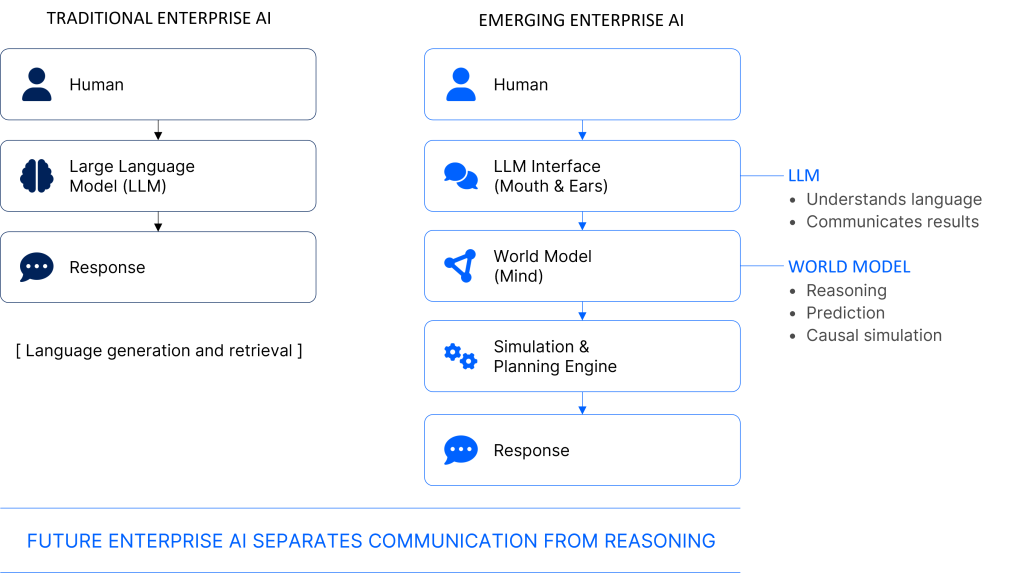
For data-rich, regulated sectors like superannuation, this solves a critical vulnerability. Today, AI sits in front of the enterprise as a chatbot wrapper. Tomorrow, it will sit inside the operational core.
Why superannuation is architecturally primed for world models
Much of what a fund does is applying fixed rules to endlessly variable human situations. Death benefit distributions apply the same legislative and trust deed provisions to family circumstances that are never the same twice. Insurance claims measure individual medical facts against fixed policy definitions. Financial advice, complaints handling, and unit pricing exception management share the shape: a stable rule set, an unpredictable reality, and an obligation to reach the same correct outcome every time the same facts recur.
This is where the architectures diverge. An LLM answers to how a case is worded, so near-identical situations described differently can produce different answers, and the reasoning is hard to audit. A rules engine is consistent but brittle, stalling on the exceptions, which is where the real work lives. A world model is suited to the ground between them: reasoning over an internal model of the rules and the member’s state rather than the surface text, which points toward outcomes that are more consistent and easier to stand behind when the facts are novel. This is a claim about direction, not a settled result, but it is the capability these processes require.
A contact centre request makes the layers concrete: “Should I consolidate my multi-employer super accounts and increase my insurance coverage?”
- Ingestion: The LLM front-end parses the member’s speech, sentiment, and intent.
- Semantic Mapping: The intent is mapped onto the fund’s data foundation, member history, product rules, regulatory bounds, and market data, organised via vector embeddings.
- Causal Simulation: The world model simulates long-term consequences across a 40-year horizon, premium erosion, fee changes, and legislative parameters.
Superannuation is a domain of state, time, and causality: multi-decade horizons and legislative ripples that take years to manifest. When this shift occurs, the determinant of AI value will be the integrity of the data foundation, not the sophistication of the front-end chatbot.
The strategic blueprint: preparing for the shift
World models are not yet commercially mature, but the data foundations they require take time to build. Organisations focused solely on front-end LLM tooling risk an irreversible competitive gap.
Architecture teams should watch for two commercial signals: the emergence of industry-specific pre-trained world models and native world-model support from major cloud providers. Either milestone will mark the tipping point toward mainstream adoption.
To prepare, business leaders should unify AI and data governance strategies and ensure operational processes are consistently documented. Technology architects should consider the shift to semantic data pipelines and eliminate interoperability gaps between core systems. Engineering teams should pilot reasoning-heavy use cases and stress-test data lineage end-to-end. The lasting competitive advantage will come not from the chatbot interface, but from the strength of the enterprise data foundation beneath it.
Whether world models ultimately displace LLMs, complement them, or evolve into something else entirely remains to be seen. More certain is that somewhat tired piece of advice that strong foundations are important. Organisations that invest here will be better positioned to take advantage of whatever comes next.
It’s genuinely exciting for us as we watch this all play out. We’re looking forward to seeing how these technologies evolve and how we can continue to put them to work in the industry.