
This is the fifth and final article in our series on superannuation’s underdeveloped operational infrastructure. We’ve worked through core IT systems, interoperability and, most recently, processes. In the very first article we filed the last of our concerns under the heading of “staffing”. It was, in hindsight, perhaps a slightly unfortunate word: it conjures rosters and headcount when the real subject is people — how they are hired, developed, organised and relied upon to keep the system running. So we’ll talk about “people” here.
The ancient Greek poet Archilochus left us a fragment that Isaiah Berlin later made famous: “the fox knows many things, but the hedgehog knows one big thing”. Superannuation operations have long been built and run by hedgehogs — deep specialists who have decades of experience in one system, one process or one product. Our argument here is that artificial intelligence is changing what the industry needs, tilting it towards the fox: the adaptable generalist with a high tolerance for change and, crucially, high social and emotional intelligence. This is not an argument against expertise — certain domains will always require deep experience. It is an argument about which kind of expertise the next decade will reward.
More fox than hedgehog
The broader labour market is already moving this way. The World Economic Forum’s Future of Jobs Report 2025 estimates that 39% of workers’ core skills will change by 2030, and ranks resilience, flexibility and agility second only to analytical thinking among the capabilities employers now prize. Tellingly, the sector the Forum labels “Insurance and Pensions Management” — our own neighbourhood — leans on these traits harder than almost any other: 94% of its employers rate resilience, flexibility and agility as core, against a global average of 67%, and 83% say the same of curiosity and lifelong learning.
The reason is not mysterious. As AI absorbs the well-defined, repeatable parts of a role, what is left for the human is the part that is ambiguous, cross-disciplinary and changeable — work that rewards someone who can move between a registry quirk, a member’s distress and a regulator’s expectation without being retrained from scratch each time. McKinsey’s research on human–machine skill partnerships makes a complementary point: more than 70% of the skills employers seek today aren’t tied exclusively to either automatable or non-automatable work, they are used across both. So most human skills will endure — but will be applied differently. The generalist who can carry those skills across changing context and effectively wield the tools, rather than compete with them on specialist knowledge, is the one who compounds in value.
The changing shape of superannuation
As AI absorbs routine processing, human effort concentrates in judgement and member care.
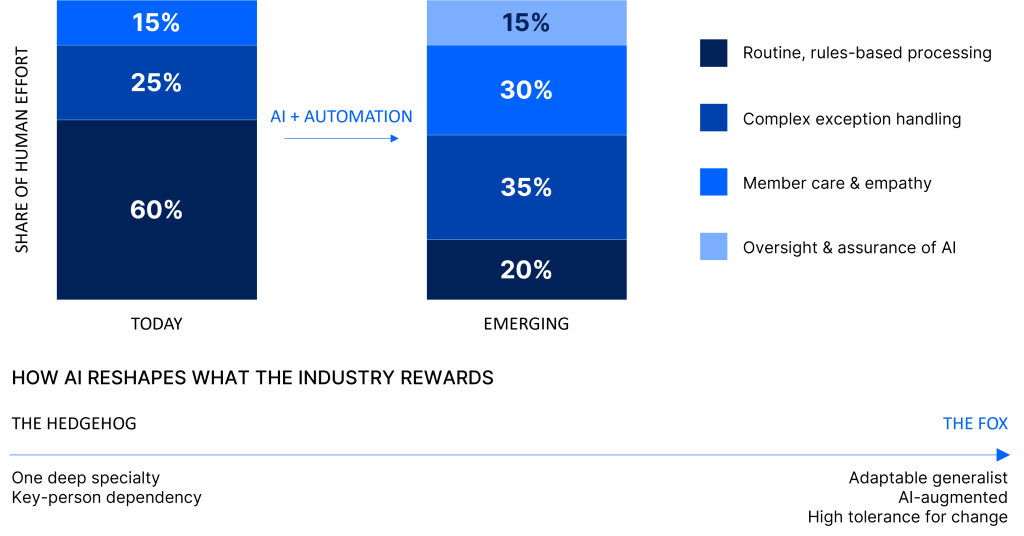
Based on early assumptions Novigi has made on the implementation of AI agents in superannuation administration.
When the exception becomes the job
In our last article we drew a line between the “happy path” — the straight-through processing that systems are designed for — and everything else: the exceptions, edge cases and reconciliations where the cost and the risk actually live. AI is very good at the happy path. What it hands back to people is a job increasingly concentrated in the exceptions, and many of those exceptions are not technical puzzles but human ones.
Consider death benefit claims. In March 2025, ASIC’s landmark review found excessive delays and, in more than a quarter of the files it examined, poor customer service — communication it called ineffective and insensitive at precisely the moment grieving families needed the opposite. The regulator’s follow-up in 2026 recorded real progress but warned that claim volumes are climbing with an ageing population, and pointed to looming mandatory member-service standards built around the timely and compassionate handling of claims. The implication for workforce design is pointed: the residual human work in superannuation is disproportionately the emotionally demanding work. Empathy, judgment and the ability to explain a hard outcome clearly are no longer nice-to-haves at the edge of the process. Increasingly, they are the process.
The apprenticeship paradox
There is a catch the industry has barely begun to confront. The judgment that exception handling demands has traditionally been built on the job — by working through thousands of routine cases until the unusual one becomes recognisable. If AI now handles the routine cases, where do the next generation of specialists serve their apprenticeship? Funds and administrators will need to be deliberate about this: designing roles, rotations and training that build seasoned judgment on purpose, rather than assuming it will accumulate as a by-product of volume that no longer exists.
Getting knowledge out of people’s heads
Which brings us to the oldest people-risk in the book. We noted in the first article of this series that superannuation’s operations lean heavily on institutional knowledge held by a small number of key people. In that context, it was expertise of legacy technologies and ageing platforms, here we’re thinking about; the one person who knows why a particular reconciliation runs the way it does, and whose annual leave is a source of some organisational nervousness. This “key-person dependency” is a resilience problem dressed up as a staffing convenience.
Here, encouragingly, AI helps rather than threatens. The same technologies reshaping the front line are unusually good at capturing, structuring and surfacing knowledge — turning the undocumented lore in someone’s head into something searchable, teachable and auditable. Done well, this democratises expertise: a newer team member, supported by good documentation and good tools, can safely handle what once required the person who “just knew”. None of this is automatic. Knowledge management does require structure and discipline. We run internal “academy” programs at Novigi precisely because getting expertise out of individual heads and into the collective takes deliberate effort. The technology lowers the cost of that effort, but on any horizon we can reasonably see today, it does not remove the need for it.
A few things worth watching
If ‘people’ are to be considered first-class operational infrastructure, a handful of questions deserve more attention:
- Change fatigue and wellbeing. What will employers do to support a workforce asked to absorb constant change and to specialise in emotionally heavy work to avoid churn?
- Accountability in AI-enabled operations. When an AI-enabled process produces an unexpected outcome, where does accountability sit, and can the reasoning behind that outcome be reconstructed months or years later if challenged by a regulator?
- The administration question. Given much member servicing is outsourced or offshored how much will those arrangements need to be reshaped with a shift towards judgment-and-empathy work?
- New pathways in. If the old ladder is disappearing, how will funds create fresh career paths into operations that do not depend on years of manual repetition?
The human touch, deliberately designed
The prevailing narrative around AI is that it allows organisations to do the same work with fewer people. What we’re digging into here — that we think is especially relevant for superannuation — is both the case for redirecting human effort and the nature of the work it is redirected towards as routine work recedes and judgment, empathy and adaptability move to the fore.
Building a workforce for that requires organisations to preserve hard-won expertise, reduce their dependence on individual knowledge holders, and deliberately develop the capabilities that become more valuable as AI takes on routine tasks. The challenge is creating an environment where deep expertise, hedgehogs, and adaptability, foxes, reinforce one another
Given where we sit — at the intersection of data, technology and operations in this industry — it is a shift we find both significant and fascinating, and one we intend to keep working through alongside our clients. Get it right, and the result should be evident to members: more efficient operations behind the scenes, and stronger human support where it’s most needed.
