
Interoperability is nearly as hard to do as it is to say. We’ve written about it before — how superannuation funds are increasingly becoming orchestrators of services and integration — and we’ve been talking about it since Novigi was barely out of nappies.
This is the third article in our series on superannuation’s underdeveloped operational infrastructure, here’s the first and second. Here we’ll explore interoperability: what it is, why it matters, and how we think it’s playing into some operational inefficiencies within the superannuation industry.
Interopera-what?
Interoperability is the ability of different systems, technologies, and organisations to exchange and use information seamlessly. It’s the goal behind most integrations and automations, and when done well it leads to greater efficiency and reduced duplication of effort.
You can talk about interoperability at the organisational level, within a company. An example would be a HR system and resource management platform being able to exchange data seamlessly so when you update an employee’s details in one system, the change automatically reflects in the other without manual intervention or mismatched records. This typically happens through system integration where APIs or middleware connect the two platforms and enable real-time or scheduled data synchronisation.
Another common example is between payroll and finance systems: salary adjustments or tax updates entered in payroll should flow through to the accounting platform without requiring duplicate entry or reconciliation. Again, this is achieved through integration — ideally using standardised data formats and automated workflows to ensure consistency and accuracy across systems.
But our focus here is industry-level interoperability: how systems, data, and technology interact across the entire superannuation ecosystem. Funds, administrators, custodians, insurers, and vendors all need to exchange predictable sets of data reliably and securely. We see this type of interoperability as lacking, and subsequently a large reason why the industry’s operational infrastructure feels fragile.
The poster child
If there’s a gold standard for interoperability in superannuation, it’s SuperStream and its associated gateway network. SuperStream introduced a consistent data format for contributions and rollovers, enabling straight-through processing between employers, funds, and the ATO. This standardisation has driven:
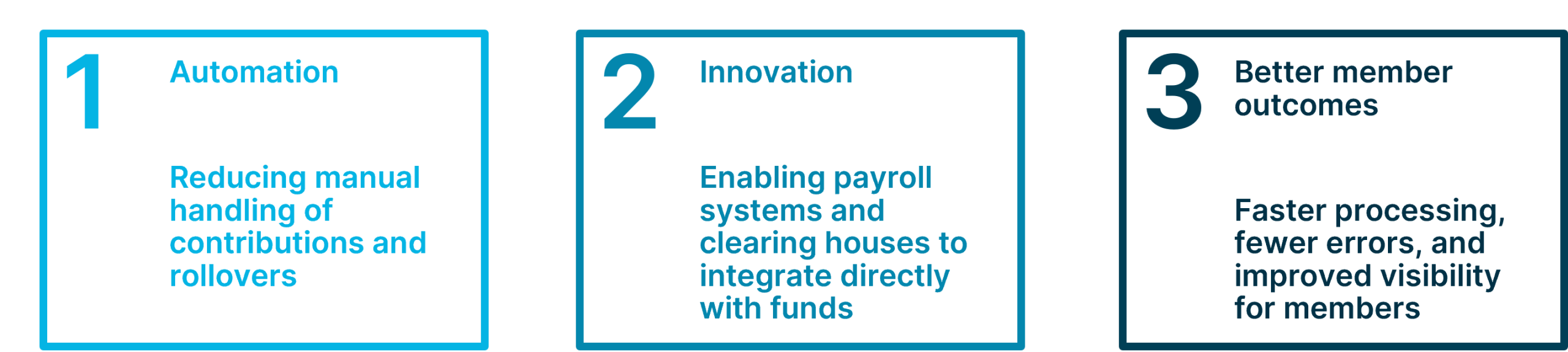
But aside from being the best example, SuperStream is really the only clear one within the industry. If you squint, there are others — MAAS and MATS reporting to the ATO also provide structured data exchange for member account and transaction reporting. Payment systems like BECS and BPAY facilitate interoperability too, though they operate as general payment infrastructure rather than solutions designed specifically for superannuation. These mechanisms work, but their scope is narrow — they’re used by super, not built for super.
In an industry with so many players — funds, administrators, custodians, insurers, and vendors — all needing to communicate with each other. What’s most striking is what doesn’t exist. Despite the clear need for superannuation funds to exchange predictable sets of data with these parties, there are too few standards and too little interoperability infrastructure. Significant gaps remain in the industry’s interoperability architecture, and even existing frameworks could be improved to enhance timeliness, data quality, and exception handling.
The missing children
So where are the biggest gaps? In our view, there are a few areas that really stand out — places where stronger interoperability could make a meaningful difference.
Fin Crime and Cyber Data Sharing Model
Interoperability in this space is critical — and currently underdeveloped. Financial crime and cyber threats have ramped up this year. Protecting members’ savings certainly shouldn’t be seen in the context of a competitive advantage. It’s in the interest of every fund, every member, and the entire country to keep retirement savings as safe as possible — there’s certainly “a rising tide lifts all boats” approach here. We see this working through structured data-sharing arrangements between funds supported by a central utility or network that enables real-time exchange of intelligence on scams and fraud attempts. Done correctly and with buy-in from regulators, agencies, and the industry, this would mean information is shared sooner, threats are prevented more effectively and widely, and collectively the industry’s defences are strengthened. Novigi has been engaging with peak bodies to explore what role we can play in helping shape and support these initiatives.
Insurance Data Standards
Insurance is another area where interoperability is sorely lacking. Today, there’s no consistent mechanism for exchanging insurance-related data — particularly claims data — between funds, insurers, and administrators. This creates inefficiencies, delays, and unnecessary friction for members at a time when they most need clarity and speed. Establishing common data standards and exchange protocols would streamline claims processing, reduce errors, and improve transparency across the value chain. We expect this to be one of the fastest-moving areas, largely driven by regulatory pressure, as the need for better member outcomes and operational resilience becomes impossible to ignore.
Retirement Solutions and Open Data
The retirement space is moving from years of ideation into an implementation phase, with new products and strategies emerging to support Australians in their post-work years. This shift creates two clear drivers for interoperability.
First, more people retiring means more people seeking advice — and good advice depends on good data. That includes super balances, bank accounts, insurance policies, retirement products, and the vast stores of critical data held by government agencies like the ATO and Centrelink — from tax records to pension entitlements. Achieving this level of connectivity requires robust data standards and guard rails that allow government, banks, funds, and other players in the wealth ecosystem to share information securely and efficiently.
Second, new retirement solutions need to integrate with the existing superannuation environment. Annuity products, for example, must work seamlessly with registry systems, member portals, CRMs, and apps. Without interoperability, these innovations risk becoming isolated silos rather than part of a cohesive member experience.
The Consumer Data Right (CDR), which underpins open banking, is the closest existing mechanism for this kind of interoperability. But it’s far from fit-for-purpose for superannuation. Significant evolution is needed to adapt CDR principles to the retirement domain and ensure data flows securely across all relevant parties. Without this, the promise of better retirement solutions will remain out of reach.
Investing in interoperability
The point here is that this industry needs better, open, and interoperable technology architectures. Without them, we’re left with inefficiencies that ultimately affect members — slower transactions, higher costs, and weaker security.
Progress in super has always been shaped by regulation. Whilst this will likely continue, industry collaboration and investment are just as essential to build the standards and frameworks that make interoperability real. Novigi will continue to barrack for changes like this, investing in and facilitating them wherever we can. We see it as a logical next step that will deliver tangible benefits for members and those in the industry.
Where superannuation falls short on Interoperability is part of The Quarterly – Q1 FY26
Key Contributor:

Ash Priest
For more information about anything you’ve read here, or if you have a more general inquiry, please contact us.