
Payday Super regulation was passed in September, which means that from 1 July 2026, employers will be required to make super contributions to their employees’ nominated funds within 7 calendar days of their regular pay cycle. All of the regulatory details of this reform are outlined in the recently published Payday Super factsheet (the factsheet), by Treasury. This change is intended to improve retirement outcomes for Australians, in part by helping to reduce incidences of missing superannuation contributions and increase member balances. However, the shift also introduces several technological challenges and opportunities for the super sector.
The factsheet highlights 5 changes that will be made to support the transition to Payday Super, including:
- The deadline for super fund to allocate or return contributions will be reduced from 20 to 3 days.
- The SuperStream data and payments standards will be revised to allow payments via the New Payment Platform (NPP) and improve error messaging so errors can be rectified sooner.
- The ATO’s Small Business Superannuation Clearing House will be retired from 1 July 2026, due to advances in payroll software solutions.
- Employers will now be able to show employees their existing “stapled” fund during onboarding, to reduce incidents of duplicate accounts.
- Advertising of super products during onboarding will be limited to MySuper products that have passed the most recent performance test.
While all 5 areas have technological implications, we think that the first two will have the greatest impact.
Reduced timeline for allocating and returning funds
The time it takes to process contributions will need to be reduced to comply with the new regulation. Presently, it takes roughly 3-7 days for an employer contribution to be processed. However, once Payday Super comes into effect, contributions will need to be processed within 3 days. The below table demonstrates the current timeline for processing contributions today.
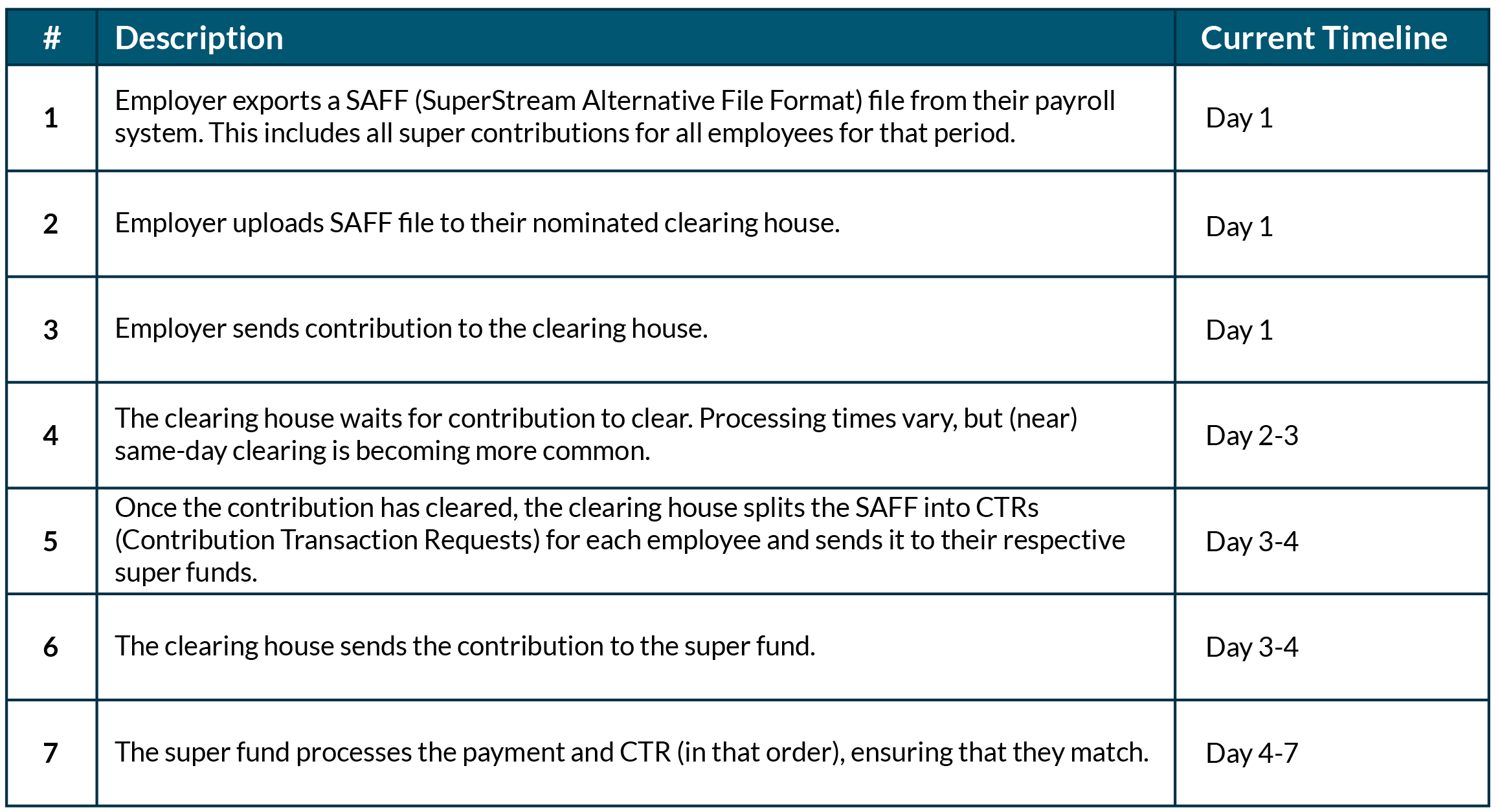
One of the biggest causes for delays is rectifying errors in employee data. To get CTER (contribution transaction error responses) to employers, so that employee data can be amended, the above process needs to be effectively reverse engineered. The back and forth can happen as many times as necessary until the superfunds can match the payment and CTR. The current process of matching is highly manual and time consuming. So, what options are available to employers to improve this process?
There are a few options to consider. One solution is for employers to adopt a system that integrates payroll solutions with clearing house platforms, to remove the need for manual SAFF files. This is the approach taken by solutions including WRKR and FlareHR. In December 2023, Rest Super’s Chief Service Officer Brendan Daly noted that “employers will soon be expected to meet increased superannuation obligations,” and that Rest Super’s collaboration with WRKR would “help employers meet these obligations in an innovative way.”
Another option to consider are solutions that enable organisations to bypass clearing houses altogether by using the New Payments Platform (NPP) — which consumers use through payment services like Osko and PayID. For example, Oban, a technology company, has developed a product called SuperSend that it is pitching as an alternative to clearing houses. This solution uses NPP to ensure that the contributions and their data reach funds faster and simultaneously. This allows for quicker identification and remediation of data errors, therefore reducing the overall timeline for contributions. Other examples include solutions leveraging stablecoin and similar digital assets, which have been touted as “super solutions”, helping employers and super funds adhere to new Payday Super regulation. However, this approach is yet to be formally adopted by any of the mega funds.
SuperStream and data errors
Payday Super will increase the frequency of transactions, potentially resulting in a higher frequency of data errors and thereby increasing the overall effort involved in exception handling. To manage this, updates to SuperStream and its data and payments standards will be required.
Over the last 10 years (yes, it has been around for that long), SuperStream has streamlined how employer contributions are made, and how the data associated with each transaction is structured and processed. However, changes to Superstream have been flagged as part of Payday Super. One of the most important updates will be enabling payments via the NPP. With NPP, transactions occur almost instantaneously, which opens the door for real-time feedback on the success or failure of each payment. If there’s an error, such as incorrect account details or insufficient funds, it can be detected and communicated back to the employer immediately. The benefits of integrating SuperStream with NPP extend beyond managing data errors — if implemented correctly, it could be instrumental in meeting the reduced timeline noted previously.
The future of Payday Super technology
Ultimately, the aim of Payday Super is to ensure that contributions are invested quicker, not just allocated to their super accounts. However, the technology that underpins the contribution and data associated with contributions needs to be carefully considered. In addition to the “transition support” items noted in the factsheet, sits the usual list of technical considerations and updates that are considered best when overhauling a system, such as:
- Increased information security.
- Integrating AI to boost the early detection of errors.
- Scalable infrastructure.
Ultimately, if we are to deliver true value for superannuation members, we need to ensure that the systems enabling the super sector are fit for purpose and meet service expectations. As more information comes to light about how the government intends to support the transition to Payday Super, super funds need to consider the following:
- Are your existing systems ready for the volume and frequency of contributions?
- Are clearing houses the best solution for your organisation?
- Can your existing systems deal with the volume of data errors?
- How can you prepare your business to adhere to the new timeline for contributions?
This article was produced as part of The Quarterly – Q1 FY25
For more information about anything you’ve read here, or if you have a more general inquiry, please contact us.
Key Contributors:

Kevin Fernandez is General Manager, Market Strategy and Propositions at Novigi, and is based in the Melbourne office.

Sophie Bowen-James is an analyst in the Market Strategy and Propositions team at Novigi, and is based in the Sydney office.