
This is the fourth article in our series on superannuation’s underdeveloped operational infrastructure. We’ve already looked at core IT systems and interoperability — both areas where shortcomings are relatively easy to see, and where remediation usually involves buying, building, or integrating technology.
Processes are different. They’re less visible, harder to measure, and much easier to rationalise as “just how things work”. And yet, when operational infrastructure fails in superannuation, it is very often a process failure that members experience — delays, errors, rework, and opaque outcomes — even when the underlying systems remain available.
Process uplift has a bad name
Process improvement initiatives have been attempted in superannuation for decades, usually with earnest intent and mixed results. There is good reason for the collective scepticism these programs now attract.
Across the business process reengineering, BPM, and broader organisational change literature, a consistent signal emerges: process transformation initiatives frequently fail to deliver their intended outcomes. The precise failure rate is contested and difficult to measure — definitions of “success” vary, benefits are rarely tracked rigorously over time, and many initiatives quietly change scope — but failure or material underperformance is widely reported as common.
This aligns neatly with lived experience. Most people working in large organisations are familiar with process uplift programs that culminate in comprehensive BPMN diagrams, detailed operating models, and limited operational change. The processes that actually run the business continue largely as before, while the artefacts become records of good intent rather than drivers of improvement.
The failure mode is not process modelling itself. It is modelling without execution — documentation mistaken for operational uplift.
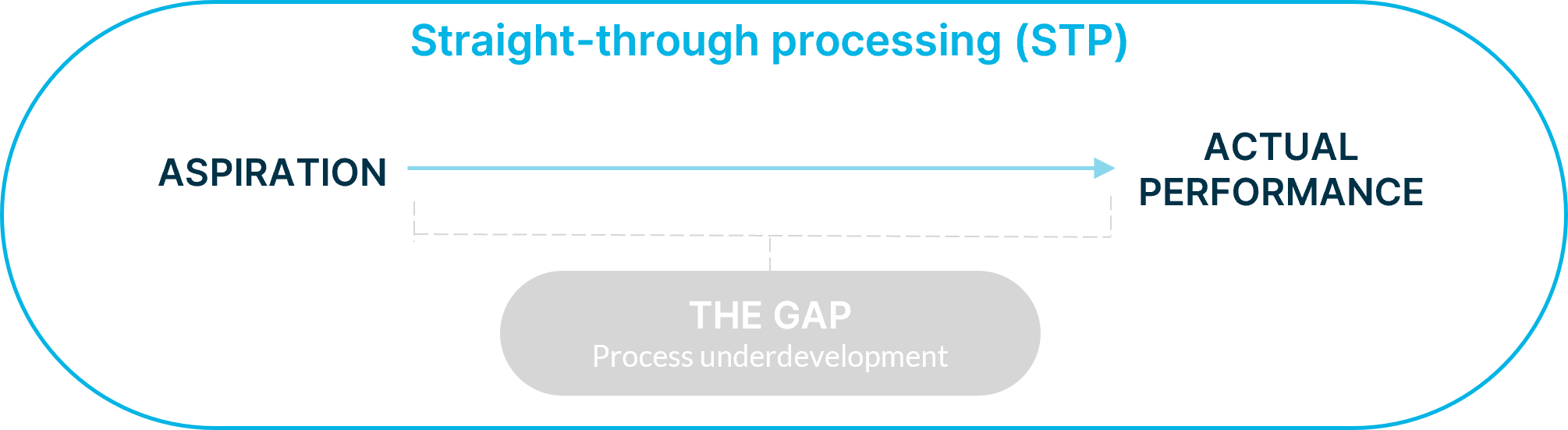
On paper, many core member processes are designed for STP. Contributions flow in, validations occur, accounts update, money moves. But in practice, a large proportion of operational effort is consumed outside the ‘happy path’ — in exceptions, edge cases, reconciliations, and manual interventions.
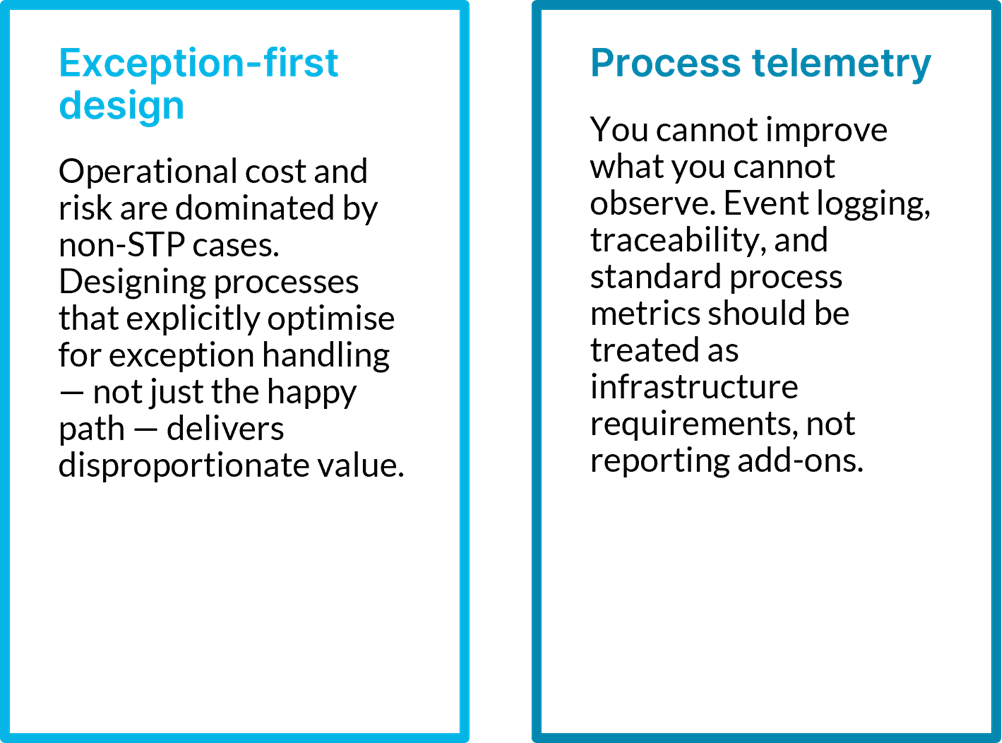
This matters because exceptions are where the cost and risk live.
Traditional process design often optimises for STP and treats exceptions as something to be handled “by the business”. Over time, exception handling becomes informal, manual, and reliant on experience rather than structure. The result is predictable: inconsistent outcomes, longer cycle times, higher operational risk, and heavy dependence on individual knowledge.
Crucially, this is not an operational failure. It is an infrastructure one. Processes were never deliberately designed to manage exceptions at scale — they were designed to describe the happy path.
Why process problems persist
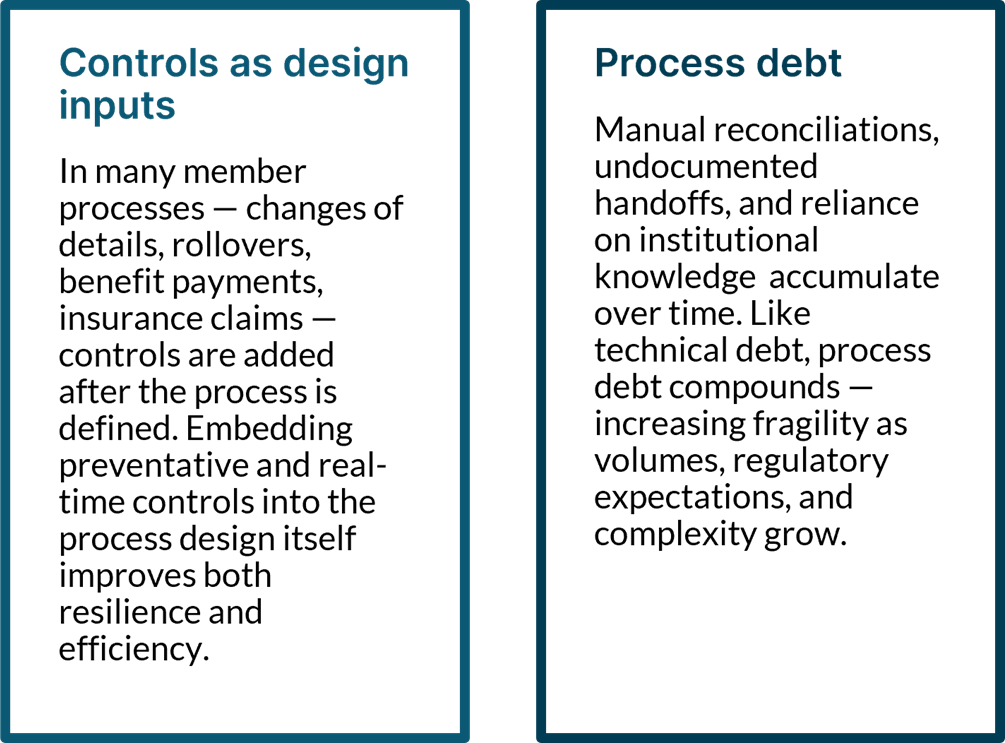
One reason process issues are so persistent is that they are often compensating mechanisms for other infrastructure gaps.
Over time, these compensations become normalised. Manual steps, shadow tools, and informal checks are seen as part of the process itself rather than signals of underdevelopment elsewhere.
There is also a natural caution at play. Many operational processes – even inefficient ones – work well enough to keep money moving and members serviced. Improving them requires touching systems, controls, and behaviours simultaneously. The perceived risk of disruption often outweighs the known inefficiencies, leading to incremental patching rather than deliberate redesign.
AI to the rescue?
Artificial intelligence materially changes what is possible in process design and execution. But it does not automatically solve the problem of underdeveloped processes.
One approach is to retain existing processes and replace humans with AI at selected steps. This can deliver quick wins:

But it also risks preserving today’s inefficiencies in silicon. An AI performing a human-shaped process will faithfully reproduce unnecessary handoffs, duplicated checks, and brittle exception handling — just faster.
The more interesting shift is to design processes explicitly for AI and humans working together.
This forces a different set of questions:
-
- What decisions are actually being made, and on what evidence?
- What decisions are actually being made, and on what evidence?
-
- Which steps are deterministic and suitable for STP, and which are genuinely judgement-based?
- Which steps are deterministic and suitable for STP, and which are genuinely judgement-based?
-
- How are exceptions classified, routed, and resolved — deliberately, or ad hoc?
- How are exceptions classified, routed, and resolved — deliberately, or ad hoc?
-
- What artefacts must be produced so outcomes can be audited, explained, and defended?
- What artefacts must be produced so outcomes can be audited, explained, and defended?
Well-designed AI-enabled processes make the boundary between STP and exception handling explicit. They define confidence thresholds, escalation paths, and verification requirements upfront. Controls are embedded into the flow, rather than layered on after the fact.
In a highly regulated environment like superannuation, this is critical. AI does not remove the need for governance. It raises the bar for process clarity and intent.
Process discovery without the theatre
AI also changes how processes can be understood and improved.
Historically, process discovery has relied heavily on workshops and interviews — asking people how work “usually” happens. This is slow, subjective, and often disconnected from reality. Modern process mining techniques, increasingly augmented by machine learning, allow processes to be inferred directly from system events, revealing real paths, real bottlenecks, and real exception rates.
For an industry that already generates enormous volumes of operational data, this is a meaningful shift. It becomes possible to reason about processes empirically: how often STP actually occurs, where exceptions cluster, how long they take to resolve, and where controls introduce friction without reducing risk.
That evidence base makes process uplift less performative and more operational.
Some underexplored pressure points
If processes are to be treated as first-class operational infrastructure in superannuation, a few areas deserve more attention than they typically receive.
Bringing processes back into the infrastructure conversation
Processes have long been the poor cousin of the operational infrastructure family — acknowledged as important but rarely treated with the same rigour as systems or data. The result is an industry where technology investment continues to rise, but operational experience often fails to improve at the same pace.
If superannuation is to achieve greater operational maturity, processes must be treated as infrastructure: deliberately designed, empirically observed, continuously improved, and increasingly executed through a thoughtful combination of straight-through processing, structured exception handling, humans, and machines.
Superannuation’s Process Problem is part of The Quarterly – Q3 FY26
Key Contributor:

Kevin Fernandez
Senior Partner
For more information about anything you’ve read here, or if you have a more general inquiry, please contact us.